Hello All,
Yesterday, my friend Pat (a fellow ATP student) and I rented a plane and flew around the Los Angeles area. The flight, which lasted about 4 hours, was fantastic! Below are a few links to share yesterday’s flight with you.
Pictures of the flight:
http://share.shutterfly.com/action/welcome?sid=9EYuWTNm0Ypk
Two videos of the flight:
http://www.youtube.com/watch?v=8GAOk4YPfcg
http://www.youtube.com/watch?v=RAFvYYYpNgA
Enjoy, and thanks for your support.
Nick
Sunday, September 9, 2007

Tuesday, September 4, 2007
Who me? Yes, I'm a multi-engine pilot!
Hello from HOT HOT HOT Riverside, California. We have had record heat here, and that combined with the smoke from the brush fires, and making flying a bit of a headache. I'm sorry I've not posted in a few days, but I've been busy getting ready my PP-MEL (Private Pilot - Multi-Engine Land) checkride with the FAA designated examiner (DE). The good news is I passed my checkride. The bad news is that I’ve only got a few days to recover before I start my instrument flying procedure training. At this point, my next checkride should be in late September.
My checkride began at 6am on Sunday morning and initially consisted of the DE asking me a series of questions to identify my knowledge of the multi-engine aircraft I fly, as well as general multi-engine flight aerodynamics questions. For example, what happens to the aircraft when it looses an engine in mid flight? For your information, the answer is not "fall out of the sky." Or, what type of fuel system does your aircraft have? For those that are learning systems, I think its best to just draw each system out on big pieces of paper, post them on your wall, and stare at them for days. Surprisingly, if you do that, you will remember them with great ease. After the hour of “grilling”, he was satisfied with my answers and said those three magical words that every pilot likes to hear during the oral portion of the checkride...."Lets Go Fly."
After hearing those three words, the DE took care of some administrative duties (Starbucks), and I went out to the flight line and began to “preflight” the aircraft for our flight. For those that are curious, the preflight of the aircraft is one of the most crucial parts of any flight, regardless of the destination, departure airport, or duration of the flight. At a minimum, you MUST check the oil, fuel quantity, tires, and the outside surface of the entire airplane. A little fluid on the ground under the wing, or a rusted rivet on the tail COULD potentially cause a problem in flight. In addition, once in the cockpit, there are numerous checklists that must be completed to ensure your flight instruments are in working order. A faulty airspeed indicator, altitude indicator, or compass could create a safety concern. Simply put, the aircraft should be airworthy before the wheels ever leave the ground. An ounce of prevention during a preflight on the ground is worth its weight in gold once up in the air. Even 10,000 hour pilots who fly a 747 still do thorough preflight’s.
When my preflight was done, the examiner came out to the aircraft and the flight portion of the exam began. Although my DE was a very relaxed guy, I still felt nervous with him the plane. Up till this point, I had only flown the plane 4 times, so I was still a little "rusty" on everything I needed to do. In this situation, I found it best to just use the checklists and pretend it just another flight. Using established procedures outlined by the manufacturer, the FAA, and ATP, I started the engines, got the updated weather information, and got taxi clearance from the tower.
After taxing to the end of the runway, I completed the engine run-up checklist to ensure the engine was working properly at full power. Now that I felt we were ready to fly, I got clearance to from the tower to taxi onto the runway for take-off. When the plane began rolling down the runway, the examiner pulled one of my engines to idle and I IMMEDIATLY completed the procedures for a failed engine on take-off. At this point, the examiner was looking to see if I know what to do when the engine stops. Do I panic? Do I swerve off the side of the runway? To I yank the controls? When he was satisfied that I did not roll of the side of the runway and I knew how to brake the aircraft, I continued a normal takeoff roll down the runway.
At 75 knots, I pulled the controls back and rotated off the runway and began climbing at 88 knots (the speed that get the Seminole the best rate of climb). For the first portion of the flight, I practiced a few "pattern" (staying close to the airport in the established traffic pattern) maneuvers. These maneuvers included a normal landing and a landing with a failed engine. For the most part, landing with a single engine is not that much different than landing with two engines. At the low power setting of the working engine, the airplane operates similar to when has two operating engines working properly. The reasons for this are a bit complex to explain in this blog, just take my word for it and don't panic if you are flying with me and the engine stops. Mom, I promise this NEVER happens in real life..hahaha
Now that my pattern work was done, I was instructed by the DE to fly south towards Lake Matthews for the rest of my examination maneuvers. During the flight to Lake Matthews we climbed to 6000 ft, so I was thankful because it was a bit cooler up there. At 6000ft over the lake, I demonstrated my steep turns, slow flying ability, stalls, and flying with a single engine. As an added bonus, this also included starting an engine while flying after I purposely shut it down. To be honest, starting an engine mid-flight is a bit easier than you would think. As long as you keep your compass heading, airspeed up, and altitude level, there is a checklist that walks you through this entire procedure. I must say, its somewhat surreal to look out of the cockpit and see your propeller STOPPED while flying.
After my maneuvers were completed, I was instructed to complete a high rate decent from 6000ft to 2000ft. The high rate decent is used if you have a medical emergency or a loss of pressurization. After descending at 120 knots we arrived at the “hard deck” of 2000ft and I knew the checkride was coming to an end. I called the Riverside airport tower, requested landing clearance, and did a nice short-field approach for landing on runway 27. Essentially, a short field approach requires the pilot to bring the airplane in a bit slower than normal, a bit lower than normal, land directly on the runway numbers, and then apply max braking in an attempt to stop in the shortest amount of runway possible. This procedure is used at those smaller airports that are not designed to handle big jets.
After taxing back to the airplanes parking spot, I was told I passed the exam and congratulated with a handshake. Now, its time to learn how to fly the airplane just using instruments and not looking outside. Mom, this is totally safe....haha
Thanks for all your support.
Nick
My checkride began at 6am on Sunday morning and initially consisted of the DE asking me a series of questions to identify my knowledge of the multi-engine aircraft I fly, as well as general multi-engine flight aerodynamics questions. For example, what happens to the aircraft when it looses an engine in mid flight? For your information, the answer is not "fall out of the sky." Or, what type of fuel system does your aircraft have? For those that are learning systems, I think its best to just draw each system out on big pieces of paper, post them on your wall, and stare at them for days. Surprisingly, if you do that, you will remember them with great ease. After the hour of “grilling”, he was satisfied with my answers and said those three magical words that every pilot likes to hear during the oral portion of the checkride...."Lets Go Fly."
After hearing those three words, the DE took care of some administrative duties (Starbucks), and I went out to the flight line and began to “preflight” the aircraft for our flight. For those that are curious, the preflight of the aircraft is one of the most crucial parts of any flight, regardless of the destination, departure airport, or duration of the flight. At a minimum, you MUST check the oil, fuel quantity, tires, and the outside surface of the entire airplane. A little fluid on the ground under the wing, or a rusted rivet on the tail COULD potentially cause a problem in flight. In addition, once in the cockpit, there are numerous checklists that must be completed to ensure your flight instruments are in working order. A faulty airspeed indicator, altitude indicator, or compass could create a safety concern. Simply put, the aircraft should be airworthy before the wheels ever leave the ground. An ounce of prevention during a preflight on the ground is worth its weight in gold once up in the air. Even 10,000 hour pilots who fly a 747 still do thorough preflight’s.
When my preflight was done, the examiner came out to the aircraft and the flight portion of the exam began. Although my DE was a very relaxed guy, I still felt nervous with him the plane. Up till this point, I had only flown the plane 4 times, so I was still a little "rusty" on everything I needed to do. In this situation, I found it best to just use the checklists and pretend it just another flight. Using established procedures outlined by the manufacturer, the FAA, and ATP, I started the engines, got the updated weather information, and got taxi clearance from the tower.
After taxing to the end of the runway, I completed the engine run-up checklist to ensure the engine was working properly at full power. Now that I felt we were ready to fly, I got clearance to from the tower to taxi onto the runway for take-off. When the plane began rolling down the runway, the examiner pulled one of my engines to idle and I IMMEDIATLY completed the procedures for a failed engine on take-off. At this point, the examiner was looking to see if I know what to do when the engine stops. Do I panic? Do I swerve off the side of the runway? To I yank the controls? When he was satisfied that I did not roll of the side of the runway and I knew how to brake the aircraft, I continued a normal takeoff roll down the runway.
At 75 knots, I pulled the controls back and rotated off the runway and began climbing at 88 knots (the speed that get the Seminole the best rate of climb). For the first portion of the flight, I practiced a few "pattern" (staying close to the airport in the established traffic pattern) maneuvers. These maneuvers included a normal landing and a landing with a failed engine. For the most part, landing with a single engine is not that much different than landing with two engines. At the low power setting of the working engine, the airplane operates similar to when has two operating engines working properly. The reasons for this are a bit complex to explain in this blog, just take my word for it and don't panic if you are flying with me and the engine stops. Mom, I promise this NEVER happens in real life..hahaha
Now that my pattern work was done, I was instructed by the DE to fly south towards Lake Matthews for the rest of my examination maneuvers. During the flight to Lake Matthews we climbed to 6000 ft, so I was thankful because it was a bit cooler up there. At 6000ft over the lake, I demonstrated my steep turns, slow flying ability, stalls, and flying with a single engine. As an added bonus, this also included starting an engine while flying after I purposely shut it down. To be honest, starting an engine mid-flight is a bit easier than you would think. As long as you keep your compass heading, airspeed up, and altitude level, there is a checklist that walks you through this entire procedure. I must say, its somewhat surreal to look out of the cockpit and see your propeller STOPPED while flying.
After my maneuvers were completed, I was instructed to complete a high rate decent from 6000ft to 2000ft. The high rate decent is used if you have a medical emergency or a loss of pressurization. After descending at 120 knots we arrived at the “hard deck” of 2000ft and I knew the checkride was coming to an end. I called the Riverside airport tower, requested landing clearance, and did a nice short-field approach for landing on runway 27. Essentially, a short field approach requires the pilot to bring the airplane in a bit slower than normal, a bit lower than normal, land directly on the runway numbers, and then apply max braking in an attempt to stop in the shortest amount of runway possible. This procedure is used at those smaller airports that are not designed to handle big jets.
After taxing back to the airplanes parking spot, I was told I passed the exam and congratulated with a handshake. Now, its time to learn how to fly the airplane just using instruments and not looking outside. Mom, this is totally safe....haha
Thanks for all your support.
Nick
Monday, August 27, 2007
First Flight
Well, today at 8am I had my first flight here at ATP. The flight was short, only about 1.5 hours, but it was the intro into flight for my multi-engine training. I practiced in the simulator all last week, so it was great to finally get in the real plane.
The Seminole is a great airplane to fly. For the most part, I felt the flight was a success. I had a couple "oh crap" moments, but after about 20 minutes of flying I got the feel for the plane. There is a "practice area" about 1o miles west of Riverside airport for the practice of maneuvers. For the most part, we practiced the maneuvers (stalls, steep turns, slow flight, single engine flight) I will need to have mastered for my multi-engine add on checkride this Saturday.
Below are two photos. The first is of the ATP location here in Riverside. For those of you that thought it was a bit "fancier," sorry. The second photo is of the plane I flew this morning. See, back in one piece.
The Seminole is a great airplane to fly. For the most part, I felt the flight was a success. I had a couple "oh crap" moments, but after about 20 minutes of flying I got the feel for the plane. There is a "practice area" about 1o miles west of Riverside airport for the practice of maneuvers. For the most part, we practiced the maneuvers (stalls, steep turns, slow flight, single engine flight) I will need to have mastered for my multi-engine add on checkride this Saturday.
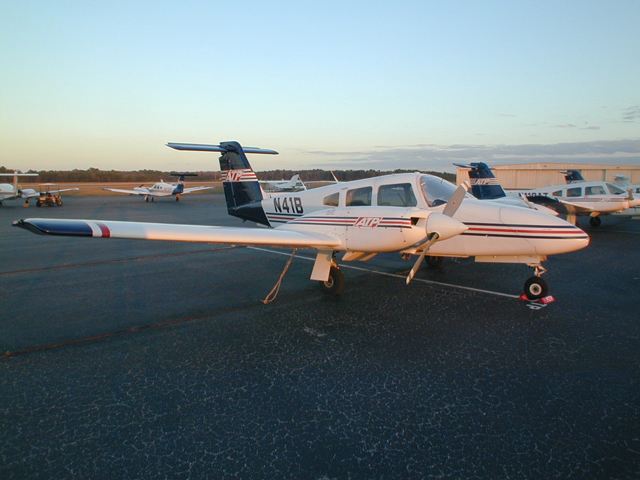
Below are two photos. The first is of the ATP location here in Riverside. For those of you that thought it was a bit "fancier," sorry. The second photo is of the plane I flew this morning. See, back in one piece.


Thanks for your support.
Nick
Nick
Monday, August 20, 2007
First Day
The first day is on the books and I love it. I've got a great instructor, the other students are friendly, and the program is well organized. There is no doubt in my mind that this was the right choice.
More updates later in the week.
Now, back to memorizing the fuel and electrical systems in GREAT detail. Basically, I need to be able to draw them on a moments notice.
Nick
More updates later in the week.
Now, back to memorizing the fuel and electrical systems in GREAT detail. Basically, I need to be able to draw them on a moments notice.
Nick
Saturday, August 18, 2007
Apartment Photos
By popular demand, below are some photos from the apartment:
The Entertainment Area (Yes, TV's still use "ears") - We have posters up on the wall to help us remember required aviation information.

The BBQ Area - This is just outside of the apartment. There is a grill and a nice grass area to toss the football around.

Parking Lot - Covered area to keep the cars out of the sun.

Garage - For the "High Rollers."
 The Wall - More posters of information we need to remember.

 Back of Apartments

Kicthen Area - Thankfully, there is a Geroge Foreman Grill

Computer Area
 Kicthen - Looking from Living Room
 Living Room - With a view of the Patio

Living Room - From the entrance to the apartment (Rob, my roommate, on the couch)

Bathroom - One of two in the apartment
 Bathroom
 Robs Side of the Bedroom
 Nicks Side of the Bedroom

The Entertainment Area (Yes, TV's still use "ears") - We have posters up on the wall to help us remember required aviation information.

The BBQ Area - This is just outside of the apartment. There is a grill and a nice grass area to toss the football around.

Parking Lot - Covered area to keep the cars out of the sun.

Garage - For the "High Rollers."
 The Wall - More posters of information we need to remember.
The Back Yard
 Back of Apartments
Kicthen Area - Thankfully, there is a Geroge Foreman Grill

Computer Area
 Kicthen - Looking from Living Room
 Living Room - With a view of the Patio
Living Room - From the entrance to the apartment (Rob, my roommate, on the couch)

Bathroom - One of two in the apartment
 Bathroom
 Robs Side of the Bedroom
 Nicks Side of the Bedroom
 Friday, August 17, 2007
In Riverside
After a stressful week and a long drive today, I finally made it to Riverside. The apartment ATP assigned to me is simple, yet very conducive to preparing me for success in the 90-day program. I will post more about the apartment (including pictures) later this weekend.
Thanks for your support, and I already miss everyone.
Nick
Thanks for your support, and I already miss everyone.
Nick
Friday, August 10, 2007
YEEESSSS!!!!!
Great news from Vegas…I passed my Instrument and CFII written exams this morning/afternoon (85% and 95%).
What a relief!!!!!!
Now, back to the Seminole Supplement in anticipation of ATP starting in 7 days.
What a relief!!!!!!
Now, back to the Seminole Supplement in anticipation of ATP starting in 7 days.
Thursday, August 9, 2007
A Chapter Done
Today was a good day, but at the same time it was memorable, and even a little sad. This afternoon I taught my last Human Resources Management class at UNLV, and looking back, I will miss it. Because I'm moving on toward my goal of becoming an airline pilot, today’s class will presumably be the last one I teach at UNLV, at least for the foreseeable future. I’ve been at UNLV for almost 10 years either in a student, graduate assistant, or instructor role. Out of all my experiences there, I enjoyed teaching the most, but that chapter of my life, for now, is over. In a week, I’m moving to California to start ATP. If all goes according to plan, starting ATP will slingshot me down the road toward my lifelong dream of flying for a major airline.
Below is a photo of my students this summer. They were really a good bunch of people who were always motivated, even if class was during the hot Las Vegas summer. As I looked around the room today, I could see the passion in their eyes. Maybe it’s because today’s class was the last of the UNLV summer session, but I like to believe it was more than that. It really hit me that my students are going to be the future leaders of the hospitality industry. As I walked out room 111 for the last time today, I smiled knowing that I had made an impact on their lives.

The second picture (below) is of the cockpit of the Piper Seminole and will be my new office for the next 90 days. My former office, room 111 in the Hotel School at UNLV, was luxuriously large compared to my new one. Room 111 was always at the perfect temperature, and all the technological components seemed to work well, most of the time. My new office is going to be cramped, hot in the summer, cold in the winter, and sometimes the instruments may not always worked as planned. But, in all honestly, I can’t wait to make the move to my new office.

I am planning on taking the Instrument and Certified Flight Instructor – Instrument written exams tomorrow. I’ll be sure to update everyone.
Thanks for your support.
Nick
Below is a photo of my students this summer. They were really a good bunch of people who were always motivated, even if class was during the hot Las Vegas summer. As I looked around the room today, I could see the passion in their eyes. Maybe it’s because today’s class was the last of the UNLV summer session, but I like to believe it was more than that. It really hit me that my students are going to be the future leaders of the hospitality industry. As I walked out room 111 for the last time today, I smiled knowing that I had made an impact on their lives.
The second picture (below) is of the cockpit of the Piper Seminole and will be my new office for the next 90 days. My former office, room 111 in the Hotel School at UNLV, was luxuriously large compared to my new one. Room 111 was always at the perfect temperature, and all the technological components seemed to work well, most of the time. My new office is going to be cramped, hot in the summer, cold in the winter, and sometimes the instruments may not always worked as planned. But, in all honestly, I can’t wait to make the move to my new office.
I am planning on taking the Instrument and Certified Flight Instructor – Instrument written exams tomorrow. I’ll be sure to update everyone.
Thanks for your support.
Nick
Saturday, August 4, 2007
The Books Have Arrived!!!!!!
Now, the fun begins.
I've got 16 days till I start ATP, 13 days till I leave for ATP, and only 7 days till I need to take the Instrument Pilot exam.
Nick
I've got 16 days till I start ATP, 13 days till I leave for ATP, and only 7 days till I need to take the Instrument Pilot exam.
Nick

Thursday, July 26, 2007
Reading
To give you an idea of how much I will be reading while in the ACPP, take a look at my assigned reading list for the 90-day program (below). This list essentially contains my “textbooks” while in flight school. To pass through the program, I need to know EVERYTHING in EACH of these.
Thankfully, the “box of books” is on the way now and I’ll be able to get some reading in before August 20th.
· Private Pilot Airplane Single Practical Test Standards Books (PTS)
· Private Pilot Airplane Multi Practical Test Standards Books (PTS)
· Instrument Pilot Practical Test Standards Books (PTS)
· Commercial Pilot Practical Test Standards Books (PTS)
· Flight Instructor Airplane Single Practical Test Standards Books
· Flight Instructor Airplane Multi Practical Test Standards Books (PTS)
· Flight Instructor Instrument Practical Test Standards Books (PTS)
· Private Pilot Oral Exam Guides
· Commercial Pilot Oral Exam Guides
· Instrument Oral Exam Guides
· Certified Flight Instructor Oral Exam Guides
· Multiengine Oral Exam Guides
· Airplane Flying Handbook
· Instrument Flying Handbook
· Aviation Instructors Handbook
· Pilot's Handbook of Aeronautical Knowledge
· Gleim Instrument Written Exam Prep
· Gleim Commercial Written Exam Prep
· Gleim Fundamentals of Instructing
· Gleim Flight/Ground Instructor FAA Written Exam
· Jeppesen Instrument/Commercial Manual JS314520
· ATP Piper Seminole Information Manual
· Jet Transition Supplement
· ASA 2007 FAR/AIM
· ATP Seminole Supplements Ver 6.3
· ATP Cessna 172 Owner Manual
· Piper Seminole Crew Procedures Training Supplement
Thankfully, the “box of books” is on the way now and I’ll be able to get some reading in before August 20th.
· Private Pilot Airplane Single Practical Test Standards Books (PTS)
· Private Pilot Airplane Multi Practical Test Standards Books (PTS)
· Instrument Pilot Practical Test Standards Books (PTS)
· Commercial Pilot Practical Test Standards Books (PTS)
· Flight Instructor Airplane Single Practical Test Standards Books
· Flight Instructor Airplane Multi Practical Test Standards Books (PTS)
· Flight Instructor Instrument Practical Test Standards Books (PTS)
· Private Pilot Oral Exam Guides
· Commercial Pilot Oral Exam Guides
· Instrument Oral Exam Guides
· Certified Flight Instructor Oral Exam Guides
· Multiengine Oral Exam Guides
· Airplane Flying Handbook
· Instrument Flying Handbook
· Aviation Instructors Handbook
· Pilot's Handbook of Aeronautical Knowledge
· Gleim Instrument Written Exam Prep
· Gleim Commercial Written Exam Prep
· Gleim Fundamentals of Instructing
· Gleim Flight/Ground Instructor FAA Written Exam
· Jeppesen Instrument/Commercial Manual JS314520
· ATP Piper Seminole Information Manual
· Jet Transition Supplement
· ASA 2007 FAR/AIM
· ATP Seminole Supplements Ver 6.3
· ATP Cessna 172 Owner Manual
· Piper Seminole Crew Procedures Training Supplement
Monday, July 23, 2007
Great News
Great News!!!
After an exhaustive interview process, I have been accepted to ATP for the Airline Career Pilot Program. If all goes well, I should put down the deposit tomorrow morning and start the program in a few weeks.
Thanks for your prayers and support.
Nick
After an exhaustive interview process, I have been accepted to ATP for the Airline Career Pilot Program. If all goes well, I should put down the deposit tomorrow morning and start the program in a few weeks.
Thanks for your prayers and support.
Nick
My Story
An integral part of the journey to become an airline pilot is the road that I have taken to get to this point my life. Although my story might be fundamentally different from every other future airline pilot, I think I’ll share my story. My hope is that the shedding of some light on how I went about making the choice to leave my “secure” life and risk it all to become a pilot. Obviously most of you know this story, but since this blog will someday gain global recognition, I want people to know the story.
Everyone has different reasons for getting into aviation, but when you hear the stories of others, you begin to pick up certain similarities. You find that as a child, you were always amazed at how those huge metal machines could fly through the air so gracefully. Then on the magical day, you got behind the controls of an aircraft, and found it amazing effortlessly to handle your 3000 pound hung of metal. You found that the plane actually became an extension of your own body. From that point forward, you knew what you were destined to do. It might not be a “direct flight” to this dream, and it might be a bumpy one, but you knew that you would make it to your destination someday.
I’ve wanted to be a pilot for as long as I could remember, and I think it’s what I was born to do. I truly believe that aviation has set up camp in my DNA, and its not going anywhere, not matter what I throw at it. My grandfather was a pilot. He was not your normal run of the mill pilot, he was a great pilot. Now mind you, I never actually saw him fly, but like the greatness of most pilots, his legend was passed down through stories from those that new him. Still today, his greatness burns in me. Some of my most prized possessions in life used to be his prized aviation possessions. Items such as his navigation tools, logbooks, and even military medals still travel with me whenever I move. The NEVER are permitted to ride in a moving truck, it’s always in the car with me.
Out of these heirlooms, the single most priceless item in this collection is his WWII flight logbook. Every single flight he flew was recorded by him in this book. It is truly irreplaceable. From the moment he started flight training, to the moment he stopped flying for the military, there is an entry in this diary. My grandfather was a B-17 and a C-47 pilot during the WWII, and then continued fly general aviation after that. Eventually, he became a flight instructor at his local flying club in Ft. Meade, Maryland. I believe, still to this day, that his love of flying is in my blood and has been passed down through the generations. Although he was a great man, I am saddened by the fact his is no longer alive. One of my few regrets in life was that my grandfather died when I was young and that he never got to see my fly. I don’t consider myself a religious person, but every time I fly, the thought of him looking down on me brings me comfort. I can sometimes look up into the clouds and see him smiling at me from above. Below is a picture of my grandfather. He was the aircraft commander of his B-17, and can been seen in the top row on the far right.

Moving one generation closer to me, my mother, although deathly scared of heights and constantly worried about the safety of her son, appreciated and supported my fascination with aviation. My first detailed aviation memory of my mother (no, I don’t remember throwing up on her as a baby moments after taking off from Athens, Greece enroute to New York), was a trip we took to Europe when I was still a small child. This trip was special for a variety of reasons. This was my first trip to Europe, I was going to see my father who was living over in Germany, and this was my first time on a 747. I remember taking off with my face pressed against the window staring out in the pitch black night looking for the slightest sign of life. A few hours after takeoff dinner was served, and when complete, I feel asleep in my seat with my head on my moms lap. Next thing I knew, it was morning and we touched down in Zurich.
In my early teens, my mom bought me Microsoft Flight Simulator, a game, that in opinion, could be one the greatest single inventions of the 20th century. Even today, I find so much pleasure in flying a “virtual” 747 from LA to Hong Kong. When my mom and I would go on vacations, she appreciated that flying was a big deal for me and made every effort to somehow incorporate aviation related stuff into our trip. I’ll give her credit; this can be difficult to do when you go places like Nova Scotia. I recall on one particular road trip, she took us several hours off our normal route just to watch planes at local airport for an hour or so. My is one of my biggest supporters, even though her motherly instinct mandates that she worry about the safety of her son, especially when he is flying. As I will mention below, without her support and blessing, I don’t know if I would be following this dream today.
My father and my uncle were both in the US Air Force and in their own respects involved somehow in aviation. My father’s love for aviation, like my grandfather’s, carried down to me as well. When I was still a child, I remember waking up early in the morning and watching my dad put the medals and ribbons on his Air Force uniform. There seemed to be hundreds of intricate pieces that he, as a Major, was required to wear on a daily basis. I remember the time and effort it took to complete that meticulous task, and I knew that one day I wanted to wear a similar uniform. Even if it wasn’t a military uniform, the white shirt and lapels of an airline pilot would meet my needs for formal attire. My father and I both loved aviation and loved to fill the time we had together with everything aspect of the hobby. My dad and I can sit and talk for hours about things related to aviation. When I was young, my dad and I would set and share dreams of flying around the country in our own airplane. When time permitted, we would go watch airplanes at the local international airport and air force base. When I was old enough, he took me for my first flying lesson. A bond was formed during this time that all pilots share, and will never lose. When I achieve something aviation related such as passing a checkride, a challenging weather filled flight, or even just a picture perfect landing in a crosswind, my dad is one of the first people I call to rejoice. No matter what time I called him, you could truly hear the excitement in his voice.
Like most people, my teen years were filled with many distractions from flying. Girls, socializing with friends, beer, sports, more girls, and getting a high school education were on the main stage. Although I flew gliders/sailplanes with my father when I was younger, by the time I reached high school, flying took a backseat. Because my grades were not good in high school, I was unable to go to an aviation university such as ERAU. To make a long story short, I decided that in addition to flying, I had another passion, the hospitality industry. The hospitality industry was a safe bet for me when I graduated from high school. For college, there was no better place to learn the art of hospitality then the University of Nevada, Las Vegas. The hotel school at UNLV was one of the best in the world, and was located about a mile off The Strip. Thankfully, I got my act together and at the end of 8 years at UNLV I received my Bachelors and Masters degrees in Hotel Administration. During that time at UNLV, I was able to obtain my private pilots license at the local flight school, and at the time, considered leaving the hotel business and going back to the airline pilot dream again. But, like most people, the thought of going so far into debt scared that pants off me. It seemed like the ideal choice was to take my degrees and go work in the hotel industry. This was a very safe bet at the time, and would end up providing me with some great experiences. The hotel business paid the bills, I got to work in some of the worlds best hospitality properties, I met some wonderful people, and I even started working on my PhD with intention of eventually teaching tomorrows hotel managers the in’s and out’s of the business.
Then, in April 2007, I began to take a long look at my life and where it was going. I was not happy. I was a full-time PhD student and instructor at UNLV, and I was good at it. But, it was the safe thing to be doing. Eventually, if I kept on this track, I would get my degree and hopefully get tenure at a university. But, would that make me truly happy? My mentor at UNLV told me that when I turn 75, I want to be able to sit in my rocker and say “I have no regrets.” Well, to be blunt, I knew that if I did not follow my dream of becoming an airline pilot, I ran the risk of having a monumental regret on my shoulders. To me, this was not something to look forward too.
With the support of my parents, and my girlfriend Lisa, I began the exhaustive research of how a major shift in profession would actually work. I began to get the answers I needed and wanted to ensure this dream come true. I realized that the first thing I needed to do was get back up in the air and see if I liked it. So, I went back to where it all began a few years earlier, my local flight school. I saw some familiar faces, but for the most part it looked very different. To my dismay, my instructor from the past had left, a corporation had come in and bough the old “mom and pop” flight school that was here before, and most shocking, the price to fly had increased A LOT. A few days later, I went up again. It was a short flight, but it was a great flight. It was like riding a bike. I got behind the controls of the Cessna, and the plane became an extension of my own body. Was I perfect? No, that’s why the call it rust.
Now came the big part. How was this going to work financially? With the support of everyone, it eventually came together. It should be noted, that without the support of Lisa, this would have never happened. In the past, I lacked the support of those close to me, and it hurt. Now I have support, and in my opinion, it’s the most important factor in my success.
Eventually, I decided where I wanted to go for flight school. A school called Airline Transport Professionals (ATP) was the best bet. They have a 90-day program called the Airline Career Pilot Program, that in my opinion, is the most effective and efficient flight school to attend if your goal is to become an airline pilot. The program is expensive and intense, but in the end, when you successfully complete it, you will be well on your way to saying “Ladies and Gentlemen, hello from the flight deck.”
Everyone has different reasons for getting into aviation, but when you hear the stories of others, you begin to pick up certain similarities. You find that as a child, you were always amazed at how those huge metal machines could fly through the air so gracefully. Then on the magical day, you got behind the controls of an aircraft, and found it amazing effortlessly to handle your 3000 pound hung of metal. You found that the plane actually became an extension of your own body. From that point forward, you knew what you were destined to do. It might not be a “direct flight” to this dream, and it might be a bumpy one, but you knew that you would make it to your destination someday.
I’ve wanted to be a pilot for as long as I could remember, and I think it’s what I was born to do. I truly believe that aviation has set up camp in my DNA, and its not going anywhere, not matter what I throw at it. My grandfather was a pilot. He was not your normal run of the mill pilot, he was a great pilot. Now mind you, I never actually saw him fly, but like the greatness of most pilots, his legend was passed down through stories from those that new him. Still today, his greatness burns in me. Some of my most prized possessions in life used to be his prized aviation possessions. Items such as his navigation tools, logbooks, and even military medals still travel with me whenever I move. The NEVER are permitted to ride in a moving truck, it’s always in the car with me.
Out of these heirlooms, the single most priceless item in this collection is his WWII flight logbook. Every single flight he flew was recorded by him in this book. It is truly irreplaceable. From the moment he started flight training, to the moment he stopped flying for the military, there is an entry in this diary. My grandfather was a B-17 and a C-47 pilot during the WWII, and then continued fly general aviation after that. Eventually, he became a flight instructor at his local flying club in Ft. Meade, Maryland. I believe, still to this day, that his love of flying is in my blood and has been passed down through the generations. Although he was a great man, I am saddened by the fact his is no longer alive. One of my few regrets in life was that my grandfather died when I was young and that he never got to see my fly. I don’t consider myself a religious person, but every time I fly, the thought of him looking down on me brings me comfort. I can sometimes look up into the clouds and see him smiling at me from above. Below is a picture of my grandfather. He was the aircraft commander of his B-17, and can been seen in the top row on the far right.
Moving one generation closer to me, my mother, although deathly scared of heights and constantly worried about the safety of her son, appreciated and supported my fascination with aviation. My first detailed aviation memory of my mother (no, I don’t remember throwing up on her as a baby moments after taking off from Athens, Greece enroute to New York), was a trip we took to Europe when I was still a small child. This trip was special for a variety of reasons. This was my first trip to Europe, I was going to see my father who was living over in Germany, and this was my first time on a 747. I remember taking off with my face pressed against the window staring out in the pitch black night looking for the slightest sign of life. A few hours after takeoff dinner was served, and when complete, I feel asleep in my seat with my head on my moms lap. Next thing I knew, it was morning and we touched down in Zurich.
In my early teens, my mom bought me Microsoft Flight Simulator, a game, that in opinion, could be one the greatest single inventions of the 20th century. Even today, I find so much pleasure in flying a “virtual” 747 from LA to Hong Kong. When my mom and I would go on vacations, she appreciated that flying was a big deal for me and made every effort to somehow incorporate aviation related stuff into our trip. I’ll give her credit; this can be difficult to do when you go places like Nova Scotia. I recall on one particular road trip, she took us several hours off our normal route just to watch planes at local airport for an hour or so. My is one of my biggest supporters, even though her motherly instinct mandates that she worry about the safety of her son, especially when he is flying. As I will mention below, without her support and blessing, I don’t know if I would be following this dream today.
My father and my uncle were both in the US Air Force and in their own respects involved somehow in aviation. My father’s love for aviation, like my grandfather’s, carried down to me as well. When I was still a child, I remember waking up early in the morning and watching my dad put the medals and ribbons on his Air Force uniform. There seemed to be hundreds of intricate pieces that he, as a Major, was required to wear on a daily basis. I remember the time and effort it took to complete that meticulous task, and I knew that one day I wanted to wear a similar uniform. Even if it wasn’t a military uniform, the white shirt and lapels of an airline pilot would meet my needs for formal attire. My father and I both loved aviation and loved to fill the time we had together with everything aspect of the hobby. My dad and I can sit and talk for hours about things related to aviation. When I was young, my dad and I would set and share dreams of flying around the country in our own airplane. When time permitted, we would go watch airplanes at the local international airport and air force base. When I was old enough, he took me for my first flying lesson. A bond was formed during this time that all pilots share, and will never lose. When I achieve something aviation related such as passing a checkride, a challenging weather filled flight, or even just a picture perfect landing in a crosswind, my dad is one of the first people I call to rejoice. No matter what time I called him, you could truly hear the excitement in his voice.
Like most people, my teen years were filled with many distractions from flying. Girls, socializing with friends, beer, sports, more girls, and getting a high school education were on the main stage. Although I flew gliders/sailplanes with my father when I was younger, by the time I reached high school, flying took a backseat. Because my grades were not good in high school, I was unable to go to an aviation university such as ERAU. To make a long story short, I decided that in addition to flying, I had another passion, the hospitality industry. The hospitality industry was a safe bet for me when I graduated from high school. For college, there was no better place to learn the art of hospitality then the University of Nevada, Las Vegas. The hotel school at UNLV was one of the best in the world, and was located about a mile off The Strip. Thankfully, I got my act together and at the end of 8 years at UNLV I received my Bachelors and Masters degrees in Hotel Administration. During that time at UNLV, I was able to obtain my private pilots license at the local flight school, and at the time, considered leaving the hotel business and going back to the airline pilot dream again. But, like most people, the thought of going so far into debt scared that pants off me. It seemed like the ideal choice was to take my degrees and go work in the hotel industry. This was a very safe bet at the time, and would end up providing me with some great experiences. The hotel business paid the bills, I got to work in some of the worlds best hospitality properties, I met some wonderful people, and I even started working on my PhD with intention of eventually teaching tomorrows hotel managers the in’s and out’s of the business.
Then, in April 2007, I began to take a long look at my life and where it was going. I was not happy. I was a full-time PhD student and instructor at UNLV, and I was good at it. But, it was the safe thing to be doing. Eventually, if I kept on this track, I would get my degree and hopefully get tenure at a university. But, would that make me truly happy? My mentor at UNLV told me that when I turn 75, I want to be able to sit in my rocker and say “I have no regrets.” Well, to be blunt, I knew that if I did not follow my dream of becoming an airline pilot, I ran the risk of having a monumental regret on my shoulders. To me, this was not something to look forward too.
With the support of my parents, and my girlfriend Lisa, I began the exhaustive research of how a major shift in profession would actually work. I began to get the answers I needed and wanted to ensure this dream come true. I realized that the first thing I needed to do was get back up in the air and see if I liked it. So, I went back to where it all began a few years earlier, my local flight school. I saw some familiar faces, but for the most part it looked very different. To my dismay, my instructor from the past had left, a corporation had come in and bough the old “mom and pop” flight school that was here before, and most shocking, the price to fly had increased A LOT. A few days later, I went up again. It was a short flight, but it was a great flight. It was like riding a bike. I got behind the controls of the Cessna, and the plane became an extension of my own body. Was I perfect? No, that’s why the call it rust.
Now came the big part. How was this going to work financially? With the support of everyone, it eventually came together. It should be noted, that without the support of Lisa, this would have never happened. In the past, I lacked the support of those close to me, and it hurt. Now I have support, and in my opinion, it’s the most important factor in my success.
Eventually, I decided where I wanted to go for flight school. A school called Airline Transport Professionals (ATP) was the best bet. They have a 90-day program called the Airline Career Pilot Program, that in my opinion, is the most effective and efficient flight school to attend if your goal is to become an airline pilot. The program is expensive and intense, but in the end, when you successfully complete it, you will be well on your way to saying “Ladies and Gentlemen, hello from the flight deck.”
Tuesday, July 17, 2007
ATP Program Interview
The nerves are starting to kick in. My mind is consumed with thoughts about my ATP entrance exam this coming Saturday. You may ask, do you need an entrance exam for a flight school? The answer is yes. This school is not your average fly by night operation that will take any Joe off the street. There are numerous requirements to be accepted into the Airline Career Pilot Program (ACCP) at ATP.
For starters, you need to meet the flight requirements. For the program I am applying for, you need to already be in possession of your Private Pilots License (PPL), with at least 85 hours of flight time. This may not seem like a lot, but when you factor in that each hour was between $100 and $200 (depending on the plane you flew, and if you took an instructor along), a significant amount of money has been invested up to this point. In addition to having your PPL, they have requirements about what type of flying you have done up to this point. They want applicants to have a certain number of “cross country” (a term used in aviation to describe flights at least 90 miles from your original airport) hours. From ATP’s perspective, this “cross country” requirement ensures that they are bringing students into the program that have flown their 85+ hours in a variety of environments, not just around their local airport.
In addition to the PPL requirements, applicants must have a First Class Medical Certificate. There are a variety of levels of medical certificate pilots can obtain, but the first class is the PhD of aviation medical certificates. This is the same level of certification that airlines pilots MUST possess. To obtain this, I had to slap $100 down to an aviation doctor here in Vegas who gave me the complete once over. Imagine taking your car to your local mechanic and saying, “I’m going on an around the world journey, and I need to make sure nothing is wrong with my car.” If you can imagine that scenario, you can imagine what getting the first class medical was like. Surprisingly, this was the most apprehensive I’ve been up to this point in Nick’s Great Aviation Adventure. Something simple like bad vision, high blood pressure, or the fact that you are currently taking a banned (by the Federal Aviation Administration) prescription medication, can shut down your dreams of becoming an airline pilot at the snap of a finger.
The above two requirements are needed to get in the door at ATP. But, before they let you toss down a check and start flying, you have to complete the process I am going to go through next Saturday. Now I applied and was accepted to the Bachelors, Masters, and PhD program at UNLV, and I’ve never seen an entrance exam/interview like this.
Saturday morning I am scheduled to arrive at the North Las Vegas airport location for ATP. What’s actually going to take place is a bit fuzzy, but from talking to current students and reading message board after message board, I think I have a good idea. Basically, there is going to be a face to face interview. From what I’ve gathered, this is where they tell you a little about the program and ask you “HR” type questions. These questions could range from tell me something good/bad about yourself, to a reason I want to become an airline pilot. I assume they want to make sure you have a good head on my shoulders. Then, once the interview is complete, I will take a written exam. The exam is short, but just about anything related to flying up to this point in my career is fair game. For the most part, up to this point, all the information I need to know I learned when I got my PPL, and am required to still know to stay current. For example, they could ask what the take off distance of the last plane I flew was. They could ask me what the emergency procedures are for a single engine aircraft if you have to abort take-off. In addition to everything related to the PPL, I will also be tested on the Piper Seminole (the multi-engine plane I will fly in Riverside) information. Now I won’t be tested on all the information, but I must be able to accurately explain things like the electrical, fuel, and braking system. In addition, I will need to know the applicable speeds for the aircraft such as the stall speed, cruise speed, and even the never exceed speed.
Once the test is completed, I will be put into an aircraft simulator. Granted, this is nothing like the ones the airlines have, but it’s a BIG step up from Microsoft Flight Simulator in my bedroom as a child. The folks at ATP want to see if I can walk the walk, not just talk the talk. You may do great on the exam and in the interview, but if you can’t fly the airplane, you are in trouble. From what I’ve heard, they understand that you may not be perfect in the simulator (especially since most have never flown a simulator, let alone a multiengine one), but they want to see that you are trainable. This is what will make or break people in the intense 90-day program at ATP. Can you be trained how to fly the airplane proficiently to the standards of airlines in 90-days. The picture below will give you some idea what the simulator is like.
For starters, you need to meet the flight requirements. For the program I am applying for, you need to already be in possession of your Private Pilots License (PPL), with at least 85 hours of flight time. This may not seem like a lot, but when you factor in that each hour was between $100 and $200 (depending on the plane you flew, and if you took an instructor along), a significant amount of money has been invested up to this point. In addition to having your PPL, they have requirements about what type of flying you have done up to this point. They want applicants to have a certain number of “cross country” (a term used in aviation to describe flights at least 90 miles from your original airport) hours. From ATP’s perspective, this “cross country” requirement ensures that they are bringing students into the program that have flown their 85+ hours in a variety of environments, not just around their local airport.
In addition to the PPL requirements, applicants must have a First Class Medical Certificate. There are a variety of levels of medical certificate pilots can obtain, but the first class is the PhD of aviation medical certificates. This is the same level of certification that airlines pilots MUST possess. To obtain this, I had to slap $100 down to an aviation doctor here in Vegas who gave me the complete once over. Imagine taking your car to your local mechanic and saying, “I’m going on an around the world journey, and I need to make sure nothing is wrong with my car.” If you can imagine that scenario, you can imagine what getting the first class medical was like. Surprisingly, this was the most apprehensive I’ve been up to this point in Nick’s Great Aviation Adventure. Something simple like bad vision, high blood pressure, or the fact that you are currently taking a banned (by the Federal Aviation Administration) prescription medication, can shut down your dreams of becoming an airline pilot at the snap of a finger.
The above two requirements are needed to get in the door at ATP. But, before they let you toss down a check and start flying, you have to complete the process I am going to go through next Saturday. Now I applied and was accepted to the Bachelors, Masters, and PhD program at UNLV, and I’ve never seen an entrance exam/interview like this.
Saturday morning I am scheduled to arrive at the North Las Vegas airport location for ATP. What’s actually going to take place is a bit fuzzy, but from talking to current students and reading message board after message board, I think I have a good idea. Basically, there is going to be a face to face interview. From what I’ve gathered, this is where they tell you a little about the program and ask you “HR” type questions. These questions could range from tell me something good/bad about yourself, to a reason I want to become an airline pilot. I assume they want to make sure you have a good head on my shoulders. Then, once the interview is complete, I will take a written exam. The exam is short, but just about anything related to flying up to this point in my career is fair game. For the most part, up to this point, all the information I need to know I learned when I got my PPL, and am required to still know to stay current. For example, they could ask what the take off distance of the last plane I flew was. They could ask me what the emergency procedures are for a single engine aircraft if you have to abort take-off. In addition to everything related to the PPL, I will also be tested on the Piper Seminole (the multi-engine plane I will fly in Riverside) information. Now I won’t be tested on all the information, but I must be able to accurately explain things like the electrical, fuel, and braking system. In addition, I will need to know the applicable speeds for the aircraft such as the stall speed, cruise speed, and even the never exceed speed.
Once the test is completed, I will be put into an aircraft simulator. Granted, this is nothing like the ones the airlines have, but it’s a BIG step up from Microsoft Flight Simulator in my bedroom as a child. The folks at ATP want to see if I can walk the walk, not just talk the talk. You may do great on the exam and in the interview, but if you can’t fly the airplane, you are in trouble. From what I’ve heard, they understand that you may not be perfect in the simulator (especially since most have never flown a simulator, let alone a multiengine one), but they want to see that you are trainable. This is what will make or break people in the intense 90-day program at ATP. Can you be trained how to fly the airplane proficiently to the standards of airlines in 90-days. The picture below will give you some idea what the simulator is like.

Once all that is complete, I then have a phone interview with the director of admissions for ATP. And of course, he can ask me anything!!!
I think I am well prepared for Saturday and the phone interview, but after reading this, hopefully you can see why my nerves are kicking in just a LITTLE.
-Nick
*Note: Since I am interviewing at the Las Vegas location of ATP, you may ask why I am going to Riverside, CA for my training? Simple, the 90-day ACPP is not offered at the Vegas location. ATP offers a wide variety of programs in addition to the 90-day.
Saturday, July 14, 2007
Riverside Trip to Look Around
We went to Riverside yesterday to check out the ATP location. It was fantastic. A current student, who I met on a message board about ATP, was nice enough to give us the VIP tour.
We met at the ATP apartments, which actually exceeded my expectations. They were fully furnished, and included everything from pots and pans to a washer and dryer. The apartments are about 20 minutes from KRAL (Riverside Municipal Airport), and thankfully pass by all sorts of shopping centers with modern conveniences like an Starbucks and Target. The walls of the apartment were covered with aviation charts, maps, checklists, and photo’s of aircraft flight controls. This was not merely for looks, but rather it was validation of how intense the environment at ATP was going to be. While the occupants of the apartment sit and eat dinner, they don’t watch The Godfather and play Playstation, they look at aviation charts and photo’s of the plane. In my opinion, this is perfect. Training to fly at this level is not something that can be done “when you feel like it.” It should encompass every waking moment of your existence.
The ATP offices at the airport were simple, yet modern. They included several lounges, two HUGE realistic aircraft simulators, and some classroom areas. Overall the place was empty of students, which was a good sign. Everyone was flying!!!!!
Once we saw the offices, we went out to see the aircraft I would be flying. The Piper Seminole is a twin engine trainer with all the modern conveniences of today’s general aviation aircraft. It has 4 seats, two separate GPS systems, and of course, all the lights and radios I’ll need in the busy LA airspace at night. Fun Fun Fun!!!
Overall, the trip was a great adventure. We got up at 530am, and were back to Vegas by 500pm. Its exactly 250 miles from the condo in Summerlin to the apartment in Riverside. Not bad for those quick runs home for some good food and some QT with the loved ones.
Below is a picture of a Piper Seminole belonging to ATP that I will be flying once the program begins.
We met at the ATP apartments, which actually exceeded my expectations. They were fully furnished, and included everything from pots and pans to a washer and dryer. The apartments are about 20 minutes from KRAL (Riverside Municipal Airport), and thankfully pass by all sorts of shopping centers with modern conveniences like an Starbucks and Target. The walls of the apartment were covered with aviation charts, maps, checklists, and photo’s of aircraft flight controls. This was not merely for looks, but rather it was validation of how intense the environment at ATP was going to be. While the occupants of the apartment sit and eat dinner, they don’t watch The Godfather and play Playstation, they look at aviation charts and photo’s of the plane. In my opinion, this is perfect. Training to fly at this level is not something that can be done “when you feel like it.” It should encompass every waking moment of your existence.
The ATP offices at the airport were simple, yet modern. They included several lounges, two HUGE realistic aircraft simulators, and some classroom areas. Overall the place was empty of students, which was a good sign. Everyone was flying!!!!!
Once we saw the offices, we went out to see the aircraft I would be flying. The Piper Seminole is a twin engine trainer with all the modern conveniences of today’s general aviation aircraft. It has 4 seats, two separate GPS systems, and of course, all the lights and radios I’ll need in the busy LA airspace at night. Fun Fun Fun!!!
Overall, the trip was a great adventure. We got up at 530am, and were back to Vegas by 500pm. Its exactly 250 miles from the condo in Summerlin to the apartment in Riverside. Not bad for those quick runs home for some good food and some QT with the loved ones.
Below is a picture of a Piper Seminole belonging to ATP that I will be flying once the program begins.
Tuesday, July 10, 2007
Intro
My name is Nick and I am preparing to embarke on a journey of a lifetime to become an airline pilot. I currently live in Las Vegas, and I am hoping to attend the ATP flight school in Riverside, California for their Airline Career Pilot Program. The entries in this forum should give the readers an idea of what its like to go through the intense training involved to become an airline pilot. My goal for this journal is to enable my friends, family, and loved ones the chance to keep up with my adventure. Please feel free to comment on each post.
If you want to take a look at the school, check out the following link.
http://www.allatps.com/
Nick
If you want to take a look at the school, check out the following link.
http://www.allatps.com/
Nick
Subscribe to:
Posts (Atom)

